
Western Medicine continues in the mindset of humoral medicine when is sees illness as a disturbance in homeostasis. Often included in the disturbance are bothersome symptoms that represent physiological responses to a challenge. The allostatic model is a current proposed that recognizes the homeostatic disturbance, argues for honoring and supporting it, but does not link it to the defenses that have been developed in the process of evolution. These defenses are most robust where we are the most vulnerable–at the openings to our bodies. Discussed here are the defenses and how to honor them of the GI and respiratory tracts.
What are our defenses Likely the greatest stimulus to Osteopathic Medicine was the 20 fold decrease in death rates seen in those post WW I flu victims treated by Osteopathic physicians. Commonly attributed to the use of manipulative medicine, Harold Magoun, Jr. took another tack when he suggested that the benefit was due to the medical profession’s use of aspirin to treat the fever and cough suppressants to treat the cough.[1] Magoun realized that a cough and a fever are physiological defenses and that hobbling them with drugs handicaps our ability to cope with our infectious challenges.
George Williams and Randolph Nesse took the same point of view in their book, Why We Get Sick: the New Science of Darwinian Medicine.[2] They point out that experimentally infected rabbits die more often when given the antipyretic drugs commonly used in our medical practices. As we argue in The Boids and the Bees:
Guiding Adaptation to Improve our Health, Healthcare, Schools, and Society the continued use of these drugs reflects our continued use of a humoral model in our medical thinking.[3] This model is based on the view that good health is reflected in the balance of the humors. While we have gotten rid of the humors–replacing them with lab values and our often bothersome, although defensive, symptoms–we have not changed the model or the nature of our thinking. The recent proposal of an allostatic model argues that environmental challenges often lead to shifts in our homeostasis, like a fever, that we need to understand and accept, but there is little evidence that it includes consideration of our other defenses.
These other defenses function where we are the most vulnerable–at the openings to our bodies. They are primary and secondary and while the primary defenses work constantly and are not symptomatic the secondary are a back up, and they are commonly bothersome enough to elicit a wrong headed treatment to balance them. We would be better served if we looked for ways to honor and support them. We look here at those of the GI and respiratory tracts.
Supporting GI Defenses The primary defenses of the GI tract are mostly the acids and enzymes in the upper GI tract that break down ingested material into their non-toxic components. But often the challenge is greater than our primary defenses can handle and the back up washing is triggered. While the nausea, vomiting and diarrhea that make up this washing are mostly more of a nuisance than life threatening it is the development of oral rehydration to cope with the life threatening case of cholera that shows us the value of honoring this defense.
The concept of oral rehydration was developed in what is now Bangladesh, which is mostly contiguous with the deltas of the Brahmaputra, Padma, and Meghna Rivers.
That many people living in a watery environment makes cholera endemic. Experience and experiments showed that drinking sugary salt solutions helped and in the early ’70’s a local NGO, BRAC, trained women to go into the communities where cholera was a problem. They told people to mix up a fist full of sugar, a pinch of salt, and a liter of water and drink enough to replace more than estimated losses. That was the beginning.
Over the next ten years it saved more lives from cholera than penicillin did for other infections in forty and the editors of Lancet called it one of the most significant medical advances of the century.[4] The chemistry and physiology behind oral rehydration is equally convincing.It works on the basis of the sodium glucose transport system, which has been measured on a molecular scale: one molecule of glucose, two molecules of sodium, and 210 molecules of water are pumped into the body from the GI tract–even when the person is vomiting.[5] It is the safest, easiest, and most efficient way we have of getting water into the body.
Oral rehydration is widely accepted in the rest of the world, but few in the U.S. are familiar with it, a situation that a conference on the subject at Princeton called lamentable. The World Health Organization recommends it as the first line treatment for all gastrointestinal illnesses. But they do not associate its benefits with supporting a physiologic defense, which is precisely what it does. If the defense of your favorite football team is optimal you don’t need much of an offense to win.
Respiratory defenses It’s similar in the respiratory tract. The primary defense of mucociliary transport works all the time, but with increasing frequency is overwhelmed and the back up washing of rhinorrhea and bothersome congestion show up in our patients who demand treatment based on TV ads. The result of this malfunction is the increase of respiratory conditions, both infectious and allergic, which have been increasing since the mid ’60’s. This timeline is best seen in extrapolating the data for ear infections [6] and better by looking at the asthma discharges from the Charleston Medical Center Hospital, which extend further back in time to show the onset of the increases in the mid sixties.[7] Multiple factors are at play but we think two that are mostly ignored are of significance: housing and drugs.
Likely the population with the greatest incidence of the upper respiratory infection we see as otitis media are the native population of Alaska. But in a visit to these people we were told by audiologists who went into the communities that the elders say they did not have the problem before they were ‘civilized’, which means taking them from their traditional homes and providing with comfortable prefab homes with a central heater.
The Indian Health Service doctors, who rarely visited the communities, discounted these reports preferring to believe they just didn’t recognize them without an otoscope.
But the pain and draining accompanying otitis media argues convincingly for the elders in this situation, and a sister community in Siberia remained free of both comfortable homes and otitis at the time of our visit. Indigenous societies around the world tell similar stories. Our own transition to central heating has been more gradual and with less noticeable problems. 1965, close to the time the increases began, marks the point when half of all new homes in the U.S. had central heating and air conditioning.
Both of these comforting measures dry the air we breathe and we have long known of the connection between humidity and respiratory illness. ‘Cold season’ corresponds to early winter when the heat goes on and the humidity drops, and adequate humidity is essential for proper much-ciliary function. This is well demonstrated in an online video-microscopy showing what happens with ciliary function when humidity is decreased done by Fisher and Paykel, a New Zealand manufacturer of humidifiers for hospitals and CPAP machines.[8]
Arundel showed years ago the connection between humidity and respiratory conditions and the graph to the right is from his article.[9] Of interest in his chart is the absence of data for respiratory infections when the humidity is greater than 50%. As the top two bars indicate both bacteria and viruses thrive in high humidity, leaving enhanced defenses as the only explanation for the lack of data.
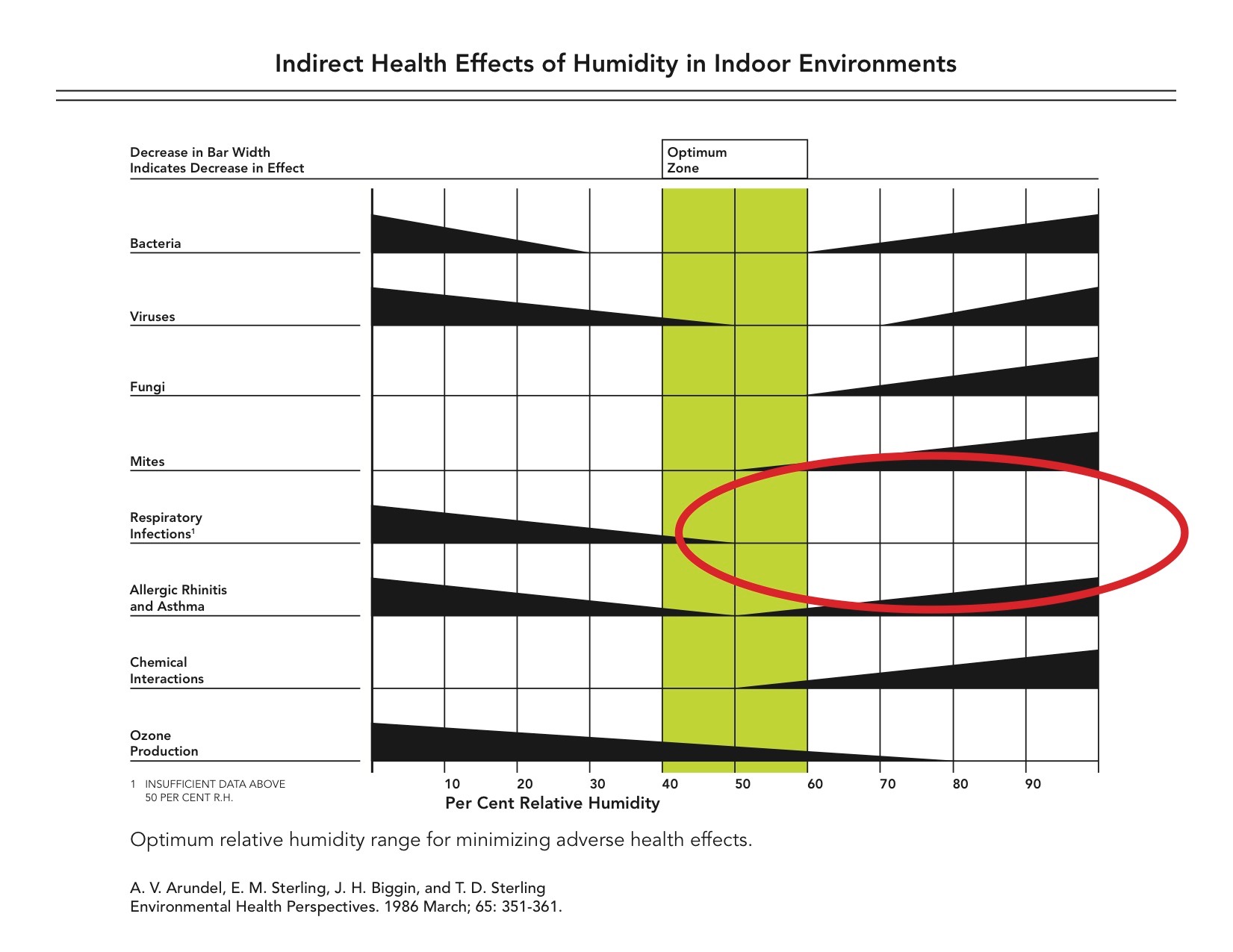
Humidity, as these references indicate, is critical for proper function of our primary defense. The role of humidity is most likely related to the volume of the airway surface fluid, an often overlooked, though critical part of the mucociliary cleaning process. The airway surface fluid supports both the cilia–by providing a fluid space in which to sweep–and the mucus–by providing the water for the concentrated goblet cell secretions to absorb to become functional mucus.
The second reason, other than decreases in humidity, is our wrong headed use of drugs to block this defense. That it is indeed a defense was the conclusion of Christer Svensson when he looked at the ultrastructure of the histamine response.[10] Histamine does four things in the nose: it opens the basement membrane to get more water for the washing; it stimulates mucin production to hold on to more pollutants; it’s an irritant–so we sneeze more and get rid of it, and; it shuts down the airway–as in asthma, to protect the more vulnerable lungs from the pollutants in the upper airway. All of these are defensive. Antihistamines were the wonder drugs of the ‘40s. They sanitized our children’s runny noses by shutting off the defense so we did not have to miss work. Again in the mid ‘60s, they were considered safe enough to be sold over the counter and advertised on TV. It wasn’t until the last decade that ‘cold pills’ were removed from the pediatric formulary and the reason given was that parental overdosing resulted in a few deaths. When I suggested to the FDA that they were seeing the results of hobbling a defense they replied only that it was an interesting idea.
Saline sprays became a popular way to cope with the dry nasal membranes that followed antihistamines, but they did not do much to reverse the problems arising from the poor mucociliary function. Something else was needed.
Xylitol had been used in Finland to prevent caries since the mid ‘70s. It works there because it decrease the adherence of Streptococcus mutans, the dental bacteria that eat the sugars in our diets and produce from them acids that eat through the enamel surfaces of our teeth. Finnish children were given five pieces of xylitol gum spaced throughout the day in school to prevent this decay. Matti Uhari and his team in Oulu, Finland found that this regimen also reduced chronic ear infections by about 40%.[11] This report corresponded to the birth of a granddaughter who began to have recurrent ear infections at 5 months when she was put into day care so her mother could return to teaching. Too young to chew gum we decided to add xylitol to saline and spray her nose prior to every diaper change. Ear infections disappeared. As written up in the Clinical Practice of Alternative Medicine 10 children with recurrent otitis had their complaints reduced by more than 90%.[12] The reasons for this success are twofold. First of all xylitol’s anti adherence effects extend to nasal as well as oral pathogens with a 5% solution resulting in a 68% reduction in Streptococcus pneumoniae.13 Secondly it works osmotically to pull water into the nasal lumen which replenishes the airway surface fluid with its beneficial effects on both cilia and mucus. This aspect of xylitol’s interaction in the nose has been extensively studied by Joseph Zabner and his group at the University of Iowa in the hope using it to treat children with cystic fibrosis.(14-19) Of further interest here is the fact that the functional part of the mucus is the multitude of carbohydrate complexes that provide adhesins for the pathogenic viruses and bacteria.[20] Seeing this adds more reason for the addition of xylitol to the mix. Xylitol is a flexible five carbon sugar alcohol so it can bend and twist and often fit into the adhesion structures on many pathogens.
In conclusion adding xylitol to the upper airway optimizes much-ciliary function so that the bothersome backup rhinorrhea occurs less often. It lasts about 6 hours in the airway so regular use is important, especially when symptomatic, but most people easily get by with preventive use twice daily.
The problem with both oral rehydration and nasal xylitol is that both are not patentable, so no ‘drug’ claims can be made by the manufacturers. This is the case because the cost of ‘drug’ testing can not be replaced when the active ingredients cannot be controlled and sufficiently priced. This is the problem both I and Dr. Zabner experienced, as well as those wishing to make drug claims for the oral use of xylitol, and it will continue until we have a better functioning public health service whose primary interest is prevention, rather than the profit oriented ‘come-back’ treatment that Chris Rock used so well to describe our health care system’s response to HIV.
References
- 1. Harold Magoun Jr, DO, FAAO, FCA, DO, ED (Hon). “More About the Use of OMT During Influenza Epidemics,” JAOA, October 2004, 104(10):406-407. ↩ Back to text
- 2. Randolph M. Nesse and George C. Williams. Why We Get Sick: The New Science of Darwinian Medicine. Random House, New York. 1995. ↩ Back to text
- 3. A.H. Jones DO with Jerry Bozeman. The Boids and the Bees: Guiding Adaptation to Improve our Health, Healthcare, Schools, and Society. The Institute for the Study of Complexity and Emergence. Phoenix, AZ. 2009. ↩ Back to text
- 4. Editors. Water with Sugar and Salt. Lancet. 1978 Aug 5; 2(8083): 300-301. ↩ Back to text
- 5. Meinild A, Klaerke DA, Loo DD, Wright EM, Zeuthen T. The human Na+- glucose cotransporter is a molecular water pump. J Physiol. 1998 Apr 1; 508(Pt 1): 15-21. ↩ Back to text
- 6. Schappert SM. Office visits for otitis media: United States, 1975-90. Adv Data. 1992 Sep 8; (214):1-19. ↩ Back to text
- 7. Crater DD, Heise S, Perzanowski M, Herbert R, Morse CG, Hulsey TC, Platts-Mills T. Asthma hospitalization trends in Charleston, South Carolina, 1956 to 1997: twenty-fold increase among black children during a 30-year period. Pediatrics 2001 Dec; 108(6): E97 ↩ Back to text
- 8. See https://www.youtube.com/watch?v=FQwqhblxz3I or search for Paykel, youtube, and mucociliary. ↩ Back to text
- 9. Arundel AV, Sterling EM, Biggin JH, Sterling TD. Indirect health effects of relative humidity in indoor environments. Environ Health Perspect. 1986 Mar;65:351-61. The chart is from page 358 of the article, which is available at https://www.ncbi.nlm.nih.gov/pmc/articles/PMC1474709/bin/envhper00436-0338.tif. Accessed 12/20/2017. ↩ Back to text
- 10. Svensson C, Andersson M, Grieff L, Persson CG. Nasal mucosal end organ hyperresponsiveness. American Journal of Rhinology, 1998, Jan-Feb; 12(1):37-43. ↩ Back to text
- 11. Uhari M. et al. Xylitol chewing gum in prevention of otitis media. British Medical Journal. 1996 Nov 9; 313(7066): 1180-84. ↩ Back to text
- 12. Jones AH. Intranasal Xylitol, Recurrent Otitis Media, and Asthma: Report of Three Cases. Clinical Practice of Alternative Medicine. 2001 Summer;2(2): 112-117. Available at http://www.commonsensemedicine.org/articles-of-interest/nasal-xylitol-from-clinical-practice-ofalternative-medicine/ ↩ Back to text
- 13. Kontiokari T, Shari M, Koskela M. Antiadhesive effects of xylitol on otopathogenic bacteria. J Antimicrob Chemoher. 1998 May;41(5):563-5. ↩ Back to text
- 14. Zabner J, Seiler MP, Launspach JL, Karp PH, Kearney WR, Look DC, Smith JJ, Welsh MJ. The osmolyte xylitol reduces the salt concentration of airway surface liquid and may enhance bacterial killing. Proc Natl Acad Sci U S A. 2000 Oct 10;97(21):11614-9. ↩ Back to text
- 15. Durairaj L, Launspach J, Watt JL, Businga TR, Kline JN, Thorne PS, Zabner J. Safety assessment of inhaled xylitol in mice and healthy volunteers. Respir Res. 2004 Sep 16;5:13. ↩ Back to text
- 16. Brown CL, Graham SM, Cable BB, Ozer EA, Taft PJ, Zabner J. Xylitol enhances bacterial killing in the rabbit maxillary sinus. Laryngoscope. 2004 Nov;114(11):2021-4. ↩ Back to text
- 17. Durairaj L, Neelakantan S, Launspach J, Watt JL, Allaman MM, Kearney WR, Veng-Pedersen P, Zabner J. Bronchoscopic assessment of airway retention time of aerosolized xylitol. Respire Res. 2006 Feb 16;7:27. ↩ Back to text
- 18. Durairaj L, Launspach J, Watt JL, Mohamad Z, Kline J, Zabner J. Safety assessment of inhaled xylitol in subjects with cystic fibrosis. J Cyst Fibros. 2007 Jan;6(1):31-4. Epub 2006 Jun 15. ↩ Back to text
- 19. Reed MD, McCombie BE, Sivillo AE, Thorne PS, Welsh MJ, March TH, McDonald JD, Seilkop SK, Zabner J, Durairaj L. Safety assessment of nebulized xylitol in beagle dogs. Inhal Toxic.2012 May;24(6):365-72. ↩ Back to text
- 20. Knowles MR and Boucher R. Mucus clearance as a primary innate defense mechanism for mammalian airways. J Clin Invest. 2002;109(5):571-577 ↩ Back to text