Illness today is seen as the lack of a proper balance of measurable symptoms. We treat those elements — fever, congestion, diarrhea, pain — but seldom look for what causes our problems in the first place. We measure blood pressure, glucose, cholesterol, and inflammatory markers, then prescribe drugs to push each number back toward a textbook normal. This mechanical view of the body treats health as a machine whose parts can be adjusted independently. It ignores the most important fact about living organisms: we adapt.
Common Sense Medicine exists to promote a paradigm shift. Not a new drug, not a new procedure, but a new way of seeing. Defense Medicine asks us to recognize that many of the symptoms we rush to suppress are not failures of the body. They are the body's defenses — intelligent, evolved responses that deserve support, not suppression.
The Mechanical Symptom Model
Modern medicine inherited a worldview from the Industrial Revolution: the body as a complex machine. When something goes wrong, find the broken part and fix it. Applied to illness, this becomes a symptom-balancing act. High blood pressure? Lower it. Runny nose? Dry it up. Fever? Bring it down. Diarrhea? Stop it.
This approach works well for genuine mechanical failures — a fractured femur, a blocked coronary artery, a bacterial meningitis that will kill without antibiotics. But it fails miserably for the chronic conditions that now dominate our healthcare spending: allergies, asthma, recurrent infections, autoimmune disorders, metabolic syndrome. These are not broken parts. They are maladapted systems — defenses that have been hobbled, redirected, or overwhelmed by a medical culture that treats every symptom as an enemy.
We have become so skilled at measuring symptoms that we forgot symptoms are messages — not malfunctions to be silenced, but communications from a body trying to restore balance.
Illness as Imbalance Ignores Adaptation
Consider fever. For centuries physicians understood that fever was the body's way of making itself inhospitable to pathogens. Higher temperature accelerates immune responses, inhibits bacterial replication, and signals the entire organism to conserve energy for healing. Yet walk into any pediatric urgent care with a febrile child and the first question is often about which antipyretic to use.
Rhinorrhea — a runny nose — is another defense we routinely sabotage. The nose produces mucus to trap, wash away, and neutralize pathogens before they reach the lungs. Antihistamines and decongestants dry the airway surface, reducing this protective flow. The patient feels better briefly because the symptom is gone, but the underlying threat remains and often worsens. Ear infections, sinusitis, and bronchitis frequently follow suppressed rhinorrhea — a pattern I documented in my own clinical practice over decades in rural New Mexico.
Diarrhea, too, is a defense. The gut evacuates toxins and pathogens rapidly. Stopping diarrhea with medication may relieve discomfort while trapping harmful organisms inside, prolonging infection and sometimes triggering complications. The mechanical model sees diarrhea as the problem. Defense Medicine sees it as part of the solution — one that may need support (hydration, electrolytes) rather than suppression.
The Lesson of Bloodletting
If you want proof that smart people with good intentions can harm patients by suppressing defenses, study the history of bloodletting. For nearly two thousand years, physicians believed that draining blood restored the balance of humors. George Washington was bled repeatedly during his final illness — more than five pints removed in his last day alone. The treatment was based on a coherent theory. Practitioners measured pulse and temperament. They had clinical experience. They were wrong.
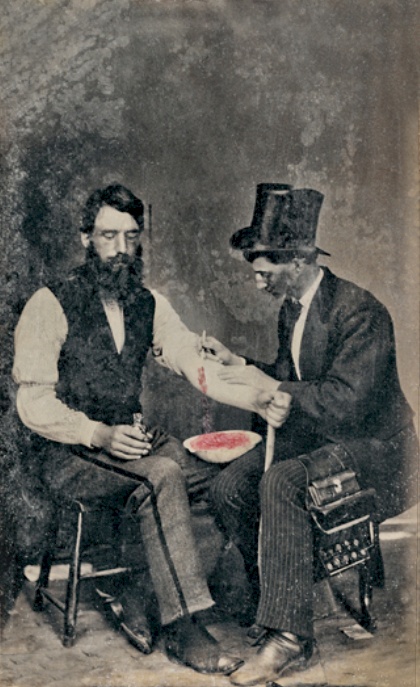
Bloodletting persisted not because physicians were stupid, but because the paradigm was wrong. They were treating a symptom — the patient's appearance of excess — without understanding what the body was trying to accomplish. When we suppress fever, dry the nose, or stop diarrhea without asking why the body initiated these responses, we risk making the same category of error with better technology and more expensive drugs.
Honoring the Body's Defenses
Defense Medicine does not reject intervention. It rejects indiscriminate intervention. Sometimes the defense itself becomes dangerous — a cytokine storm in COVID-19, a fever high enough to cause seizures in a small child, dehydration from prolonged diarrhea. In those cases, judicious suppression is appropriate. But the default should be support, not suppression.
Supporting defenses means asking different questions at the bedside:
- What is the body trying to accomplish with this symptom?
- Is this defense functioning adequately, or has it been impaired?
- What environmental or iatrogenic factors may be weakening the patient's adaptive capacity?
- Can we strengthen the defense rather than override it?
This is not mysticism. It is systems thinking applied to biology — the same shift that transformed ecology, economics, and computer science when analysts stopped treating complex systems as simple machines.
The Nose as a Case Study
The upper airway offers a concrete illustration. The nose is not a passive tube. It is an active defense organ — filtering, humidifying, warming, and washing inspired air while producing antimicrobial substances in the airway surface liquid. When this system works well, pathogens are cleared before they cause disease. When it is impaired — by dry air, allergens, antihistamines, or anatomical obstruction — infections migrate to the ears, sinuses, and lungs.
Upper respiratory problems have increased dramatically since the 1970s, coinciding with the widespread use of antihistamines and decongestants that suppress rhinorrhea. My clinical work with xylitol nasal spray grew directly from this observation: rather than drying the nose or killing its bacteria, we could support its natural washing mechanism. The results — over 90% reduction in recurrent ear infections — validated the defense-oriented approach. I explore the science behind this in Killing Germs Doesn't Work; Let's Try Feeding Them.
Complex Adaptive Systems
Human beings are complex adaptive systems. We adapt through decentralized processes — immune cells communicating locally, mucosal surfaces responding to microbial communities, neural and hormonal networks adjusting in real time. No central controller manages these interactions. No single measurement captures the system's state.
Complex adaptive systems share key properties: they self-organize, they learn from experience, they respond nonlinearly to interventions, and they resist reduction to simple cause-and-effect chains. Pushing one variable (blood pressure, cholesterol, nasal congestion) often shifts others in unpredictable ways. The body compensates. Side effects emerge. New symptoms appear — sometimes months or years later.
Our analytical model of healthcare — born in the era of the assembly line — cannot honor this complexity. It demands measurable targets, standardized protocols, and pharmaceutical solutions that fit billing codes. Defense Medicine offers an alternative: work with the body's adaptive intelligence rather than against it. Prevent problems by strengthening defenses. Treat illness by asking what the symptom is trying to accomplish before silencing it.
What Changes When We See Differently
A paradigm shift is not a single discovery. It is a change in what we pay attention to — what we consider normal, what we consider pathology, and what we consider treatment. When physicians learn to see fever as defense rather than disease, they hydrate and monitor rather than reflexively medicate. When patients understand that a runny nose is their airway cleaning itself, they reach for saline and xylitol rather than antihistamines. When policymakers recognize that prevention strengthens defenses at pennies on the dollar, they fund nasal hygiene and health savings accounts instead of only crisis care.
Common Sense Medicine was founded to advance this shift — through research, education, and the practical tools of defense medicine. The goal is not to reject modern medicine but to complete it: to add the dimension of adaptation that the mechanical model left out. We have spent a century learning to treat effects. It is time to learn to support causes — the body's own remarkable capacity to heal, adapt, and defend itself.
Seeing with new eyes is the first step. Everything else — the research, the clinical protocols, the healthcare reform — follows from that changed vision.